Skip to main contentEngineering Courses, Mentoring & Jobs | EveryEng
Know your Power Plant Generator - About Internals, Erection Process & Maintenance. banner
Live Online Class Beginner

Know your Power Plant Generator - About Internals, Erection Process & Maintenance.

465 views
$ 20
2 hrs
Next month
English , Hindi
465 views

Vijay Sachdev
Vijay SachdevConsultant - Project & Procurement
  • 7-day money-back guarantee
  • Session recordings included
  • Foundational Learning
  • Access to Study Materials

Is this course for you?

You should take this if

  • You work in Energy & Utilities or Mechanics & Turbomachinery
  • You're a Mechanical / Instrumentation professional
  • You prefer live, instructor-led training with Q&A

You should skip if

  • You need a different specialisation outside Mechanical
  • You need fully self-paced, on-demand content

Opportunities that await you!

Career opportunities

Training details

This is a live course that has a scheduled start date.

Why people choose EveryEng

Industry-aligned courses, expert training, hands-on learning, recognized certifications, and job opportunities-all in a flexible and supportive environment.

$20

$0 Early bird

Coming in Next Month

Questions and Answers

A: Common challenges during power plant generator installation include ensuring precise alignment between the turbine and generator shaft, managing heavy equipment lifting and placement within limited space, handling magnet and winding sensitivities, and maintaining clean environments to avoid contamination of insulation materials. Additionally, coordinating installation with other plant construction activities and adhering to strict project schedules can be difficult. Electrical testing and commissioning steps require meticulous planning to prevent delays. Addressing these challenges often requires experienced personnel and proper tools. For more info, check out the IEC and API guidelines on installation best practices: https://www.api.org/products-and-services/standards

A: Regular maintenance of a power plant generator is crucial to ensure efficiency and longevity. It involves routine inspections such as checking insulation resistance, bearing conditions, cooling systems, and excitation systems. Preventive maintenance includes cleaning, lubrication, tightening electrical connections, and testing winding resistance. Periodic overhauls may require disassembling the rotor and stator for detailed inspection and repair of any wear and tear. Condition monitoring techniques like vibration analysis, thermography, and partial discharge testing are also employed to detect early signs of faults. Standards and best practices can be found in IEEE Std 762 and various manufacturer manuals. For detailed guidance, refer to: https://www.ge.com/power/services/maintenance-and-reliability-equipment-maintenance

A: Yes! Synchronous generators operate at a constant speed synchronized with the grid frequency, producing electricity with a constant voltage and frequency. They have rotors excited by DC current to create a magnetic field. These are predominantly used in large power plants. Asynchronous generators, or induction generators, operate at a speed slightly different from grid frequency and usually require an external reactive power supply. They are simpler and often used in smaller or variable speed applications like wind turbines. The synchronous generator's advantage lies in better control of power factor and voltage regulation. For a detailed comparison, you may visit: https://electricalacademia.com/generators/differences-between-synchronous-and-asynchronous-generators/

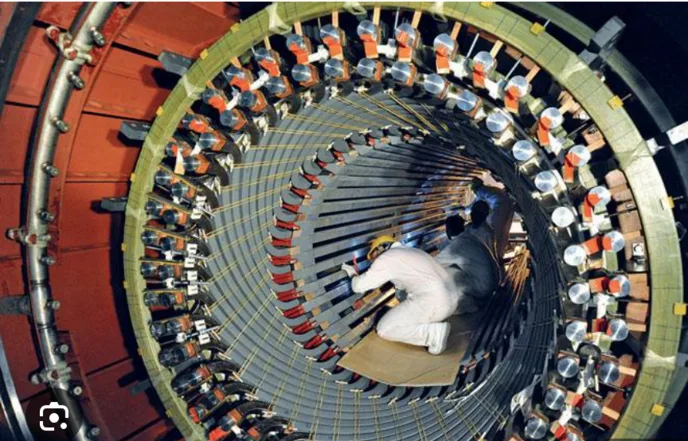
A: The erection process of a power plant generator involves several critical steps. First is site preparation including foundation inspection for levelness and alignment. Then, delivery and staging of generator components happen, followed by assembly of the stator core and winding installation. Next, the rotor installation and alignment are performed with precision. After mechanical assembly, electrical connections and testing of insulation resistance are done. The cooling system and lubrication systems are installed and checked. Finally, commissioning tests like no-load and full-load runs are performed. Each step must adhere to strict safety and quality protocols. For more detailed procedures and standards, see the EPRI guidelines or this resource: https://www.powermag.com/power-plant-generator-erection-installation/