Skip to main contentEngineering Courses, Mentoring & Jobs | EveryEng
First Law of Thermodynamics in Closed System by PK NAG (Chapter 04) banner
Self-paced Beginner

First Law of Thermodynamics in Closed System by PK NAG (Chapter 04)

9
32 enrolled
3310 views
$ 10
273 min
Anytime
Hindi
3310 views
Saurabh Kumar Gupta
Saurabh Kumar GuptaMechanical Engineer
  • 7-day money-back guarantee
  • Lifetime access
  • Foundational Learning
  • Access to Study Materials

Is this course for you?

You should take this if

  • You work in Aerospace or HVAC
  • You're a Mechanical professional
  • You prefer self-paced learning you can revisit

You should skip if

  • You need a different specialisation outside Mechanical
  • You need live interaction with an instructor

Course details

Course suitable for

Course content

The course is readily available, allowing learners to start and complete it at their own pace.

11 lectures4 hr 33 min
  1. Introduction to the first law of thermodynamics for closed system
    27 min
  2. Numerical-1
    24 min
  3. Numerical-2
    25 min
  4. Heat Transfer For Various Process
    34 min
  5. Perpetual Motion Machine of First Kind
    3 min
  6. Free Expansion of Gases
    14 min
  7. Solved Example PK NAG Book
    34 min
  8. Problems with Hint PK Nag Chapter -4
    26 min
  9. Pk Nag Problems Chapter-4
    27 min
  10. Pk Nag Problems Chapter-4
    42 min
  11. Numerical
    17 min

Opportunities that await you!

Career opportunities

Course Attachments

lec-19.pdf

lec-20.pdf

lec-21.pdf

lec-22.pdf

lec-23.pdf

lec-24.pdf

lec-25--.pdf

lec-26.pdf

lec-27.pdf

lec-28.pdf

lec-29.pdf

Why people choose EveryEng

Industry-aligned courses, expert training, hands-on learning, recognized certifications, and job opportunities-all in a flexible and supportive environment.

$10

Access anytime

Questions and Answers

A: In a cyclic process, the system returns to its initial state at the end of the cycle, so the net change in internal energy over one complete cycle is zero (\( \Delta U = 0 \)). According to the First Law, \( 0 = Q - W \) or \( Q = W \). This means the net heat added to the system equals the net work done by the system during the cycle. This principle is fundamental in thermodynamic cycles such as engines and refrigerators. PK NAG’s chapter on the First Law covers cyclic processes and their importance in practical thermodynamics.

A: In an adiabatic process, the system exchanges no heat with its surroundings (Q = 0). According to the First Law \( \Delta U = Q - W \), this reduces to \( \Delta U = -W \). This means that any work done by the system leads to a decrease in internal energy, and work done on the system increases internal energy. Adiabatic processes are common in thermodynamics, and PK NAG discusses them in detail, including how they affect temperature, pressure, and volume changes in closed systems.

A: In the First Law of Thermodynamics, work (W) and heat (Q) are two different modes of energy transfer. Work is energy transfer due to any force acting through a distance, such as boundary work during expansion or compression of a gas. Heat, on the other hand, is energy transfer due to temperature difference between the system and its surroundings. While both affect the internal energy of the system, they are fundamentally different processes. PK NAG’s book provides examples and detailed explanations that help clarify this distinction.

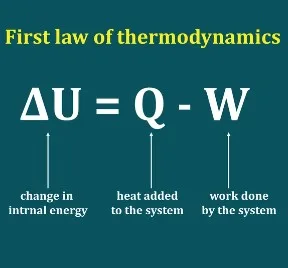
A: The First Law of Thermodynamics for a closed system states that the change in the internal energy of the system is equal to the net heat added to the system minus the work done by the system on its surroundings. Mathematically, it is expressed as \( \Delta U = Q - W \). This law essentially represents the conservation of energy principle, taking into account heat and work interactions. For a closed system, no mass crosses the system boundary, so energy transfer occurs only via heat and work. More details can be found in PK NAG's textbook "Engineering Thermodynamics", Chapter 04.